Monday, January 19th 2026
How to Animate Old Photos with AI: Step-by-Step Guide
Posted by
To animate an old photo with AI, upload a family photo to Animate Old Photos, optionally describe a movement such as “The woman smiles gently and blinks,” choose a video model, and click Animate Old Photo. You can then preview and download the video. For speech, singing, or music, select a model that supports audio and enable Generate Audio.
This step-by-step guide shows you how to turn old photos into videos, choose suitable photos, write effective motion prompts, and use model and audio settings. You’ll also see video examples that demonstrate how different prompts shape the results.
Quick answer: No video editing experience is needed. Upload an old photo, choose a movement, and generate your video in a few simple steps.
Why Bring Old Photos to Life?
- Revisit family moments: Animate family photos of parents, grandparents, and other loved ones with subtle smiles, blinks, or waves.
- Share family history: Turn a still photo into a short video for birthdays, reunions, or a family archive.
- Create memorial tributes: Make a personal tribute video while preserving the original photograph separately.
How Does AI Old Photo Animation Work?
Animate Old Photos is an AI photo-to-video tool. It uses your uploaded picture as a starting point and generates new frames to simulate movement, such as blinking, smiling, waving, or a subtle head turn. You can leave the prompt blank or describe a specific action. Video duration and available features depend on the selected model.
Unlike simply panning across a still image, AI photo animation creates movement within the photo, such as a person smiling, blinking, or gently turning their head. For the best results, use a clear photo and start with simple movements.
How to Animate Old Photos in 7 Steps
Follow these seven steps to upload a photo, choose its movement, generate a video, and save the result. You can skip the optional prompt and audio settings if you only want simple motion.
1. Open the Animate Old Photos Tool
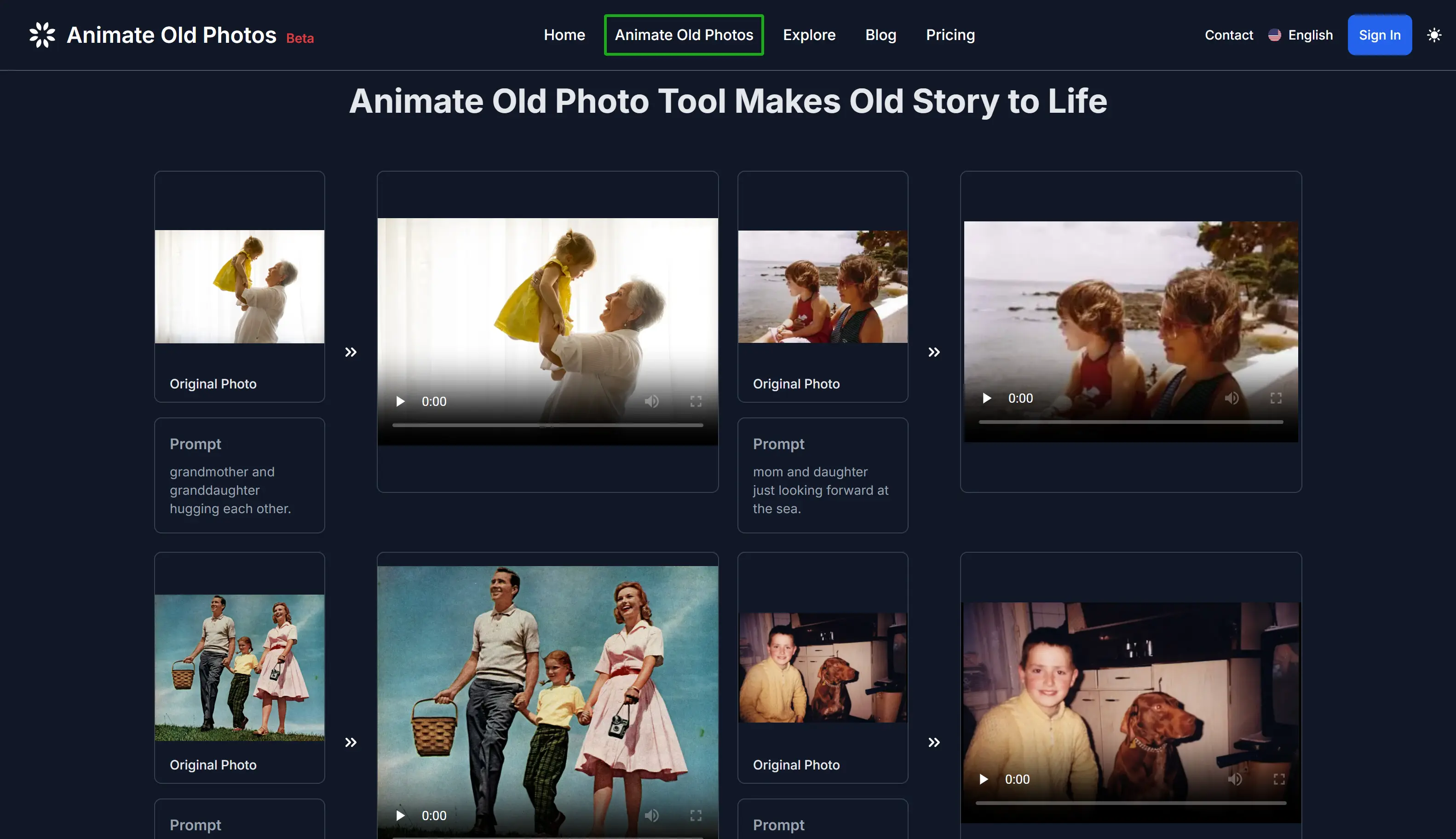
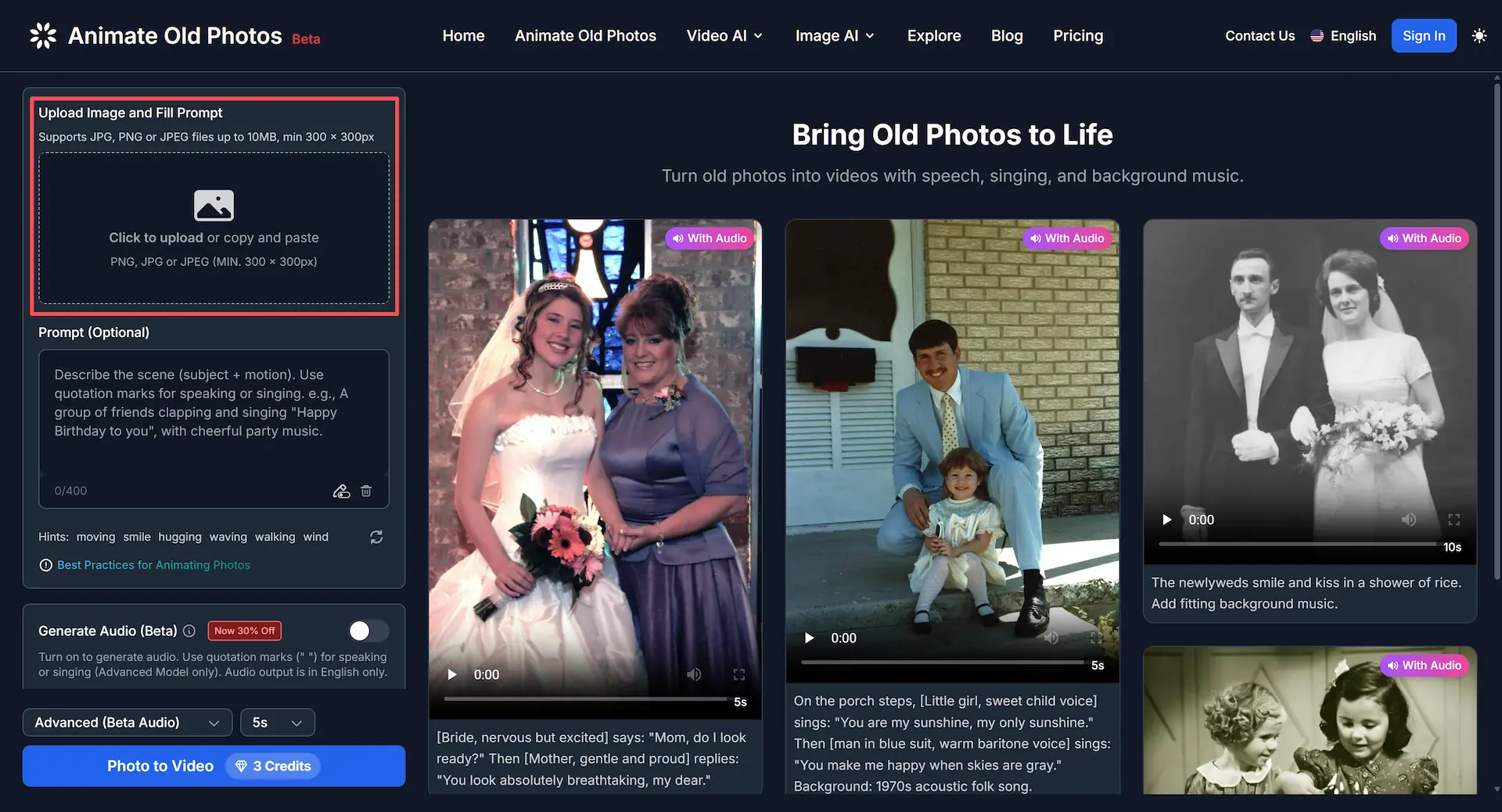
Go to Animate Old Photos. The photo upload form is right on the home page, so you can start by choosing the picture you want to animate.
2. Upload Your Old Photo
Click the upload area and choose an image from your device, or paste one from your clipboard. The current upload form accepts PNG, JPG, and JPEG images, with a 10MB maximum and a minimum resolution of 300 × 300 pixels.
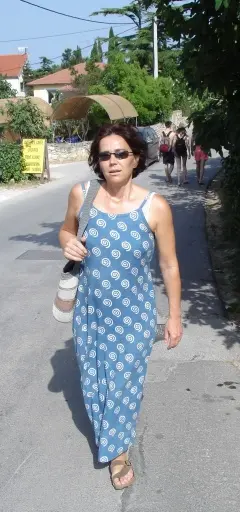
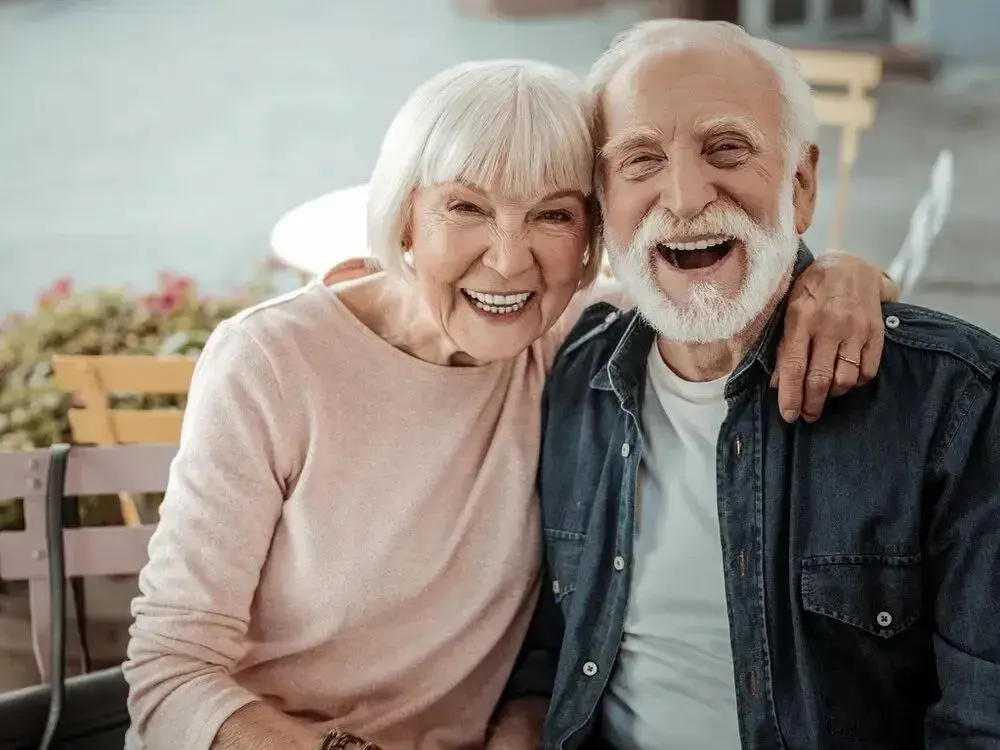
For more natural animation, start with a well-lit photo where faces are clearly visible. You can also animate black-and-white photos; colorization is not required if facial details are clear. One or two prominent subjects and a simple background are good starting points for natural-looking motion.
Choosing the Right Photos for Video Generation
High-Quality Photos
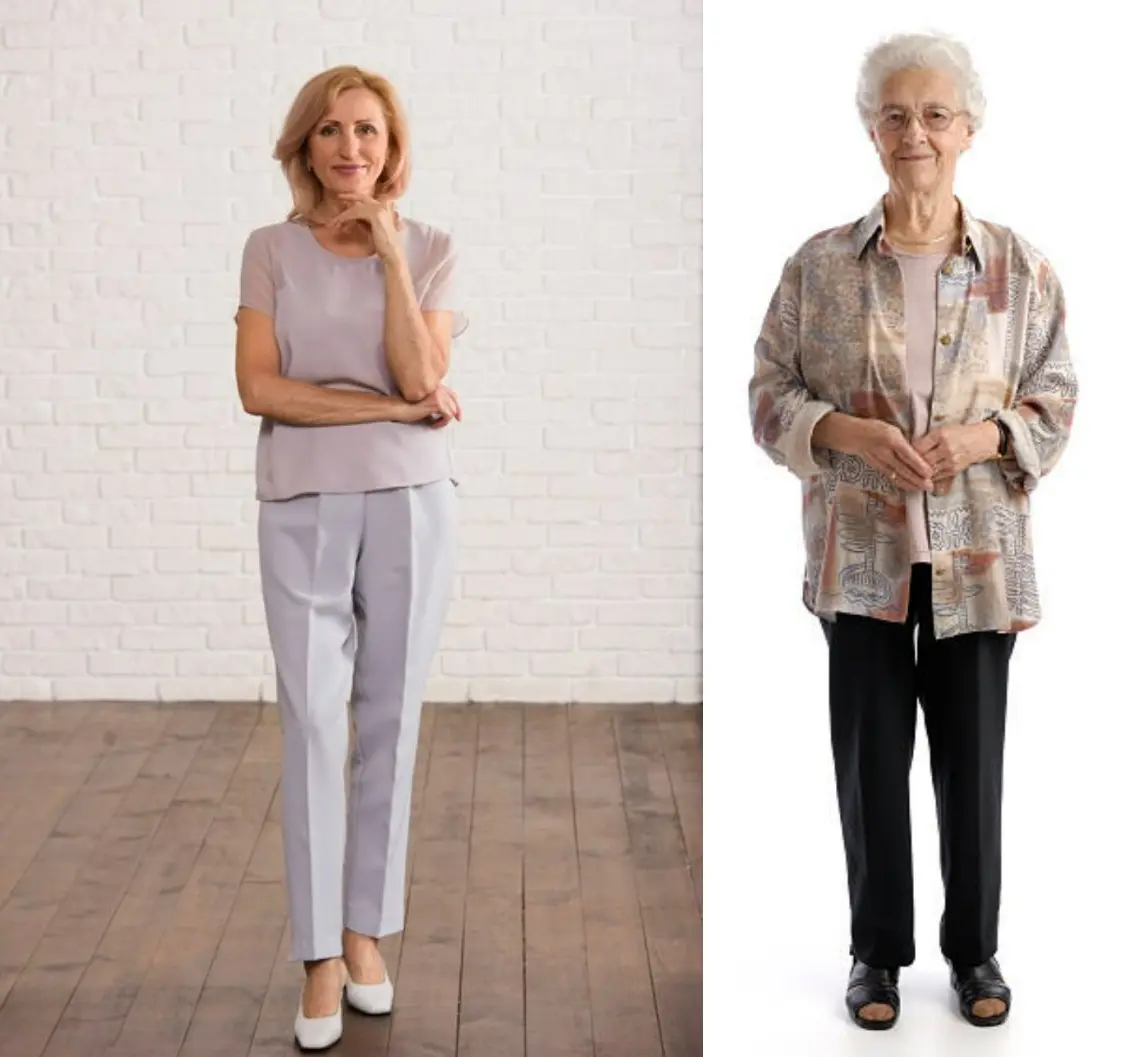
Low-Quality Photos
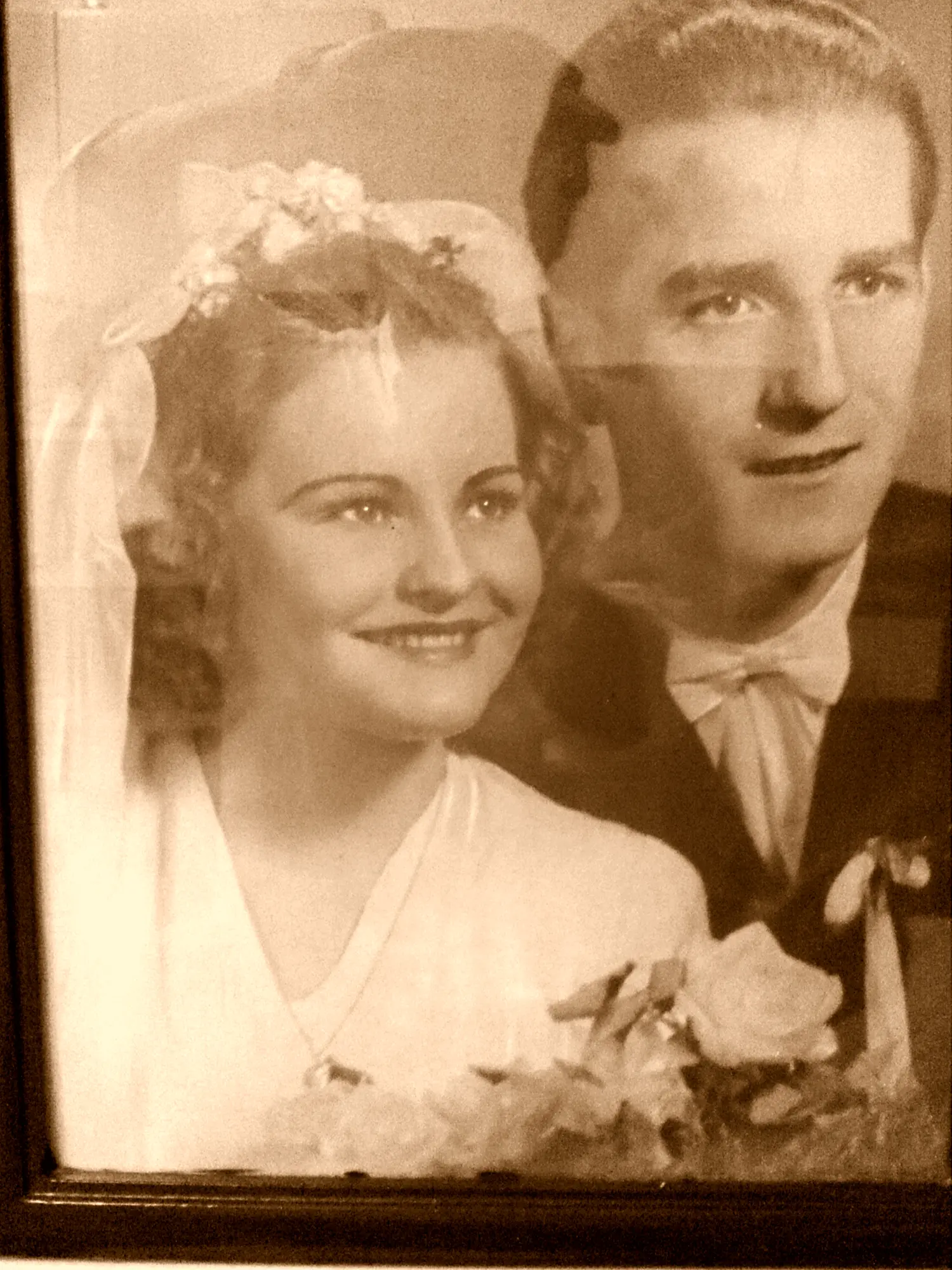
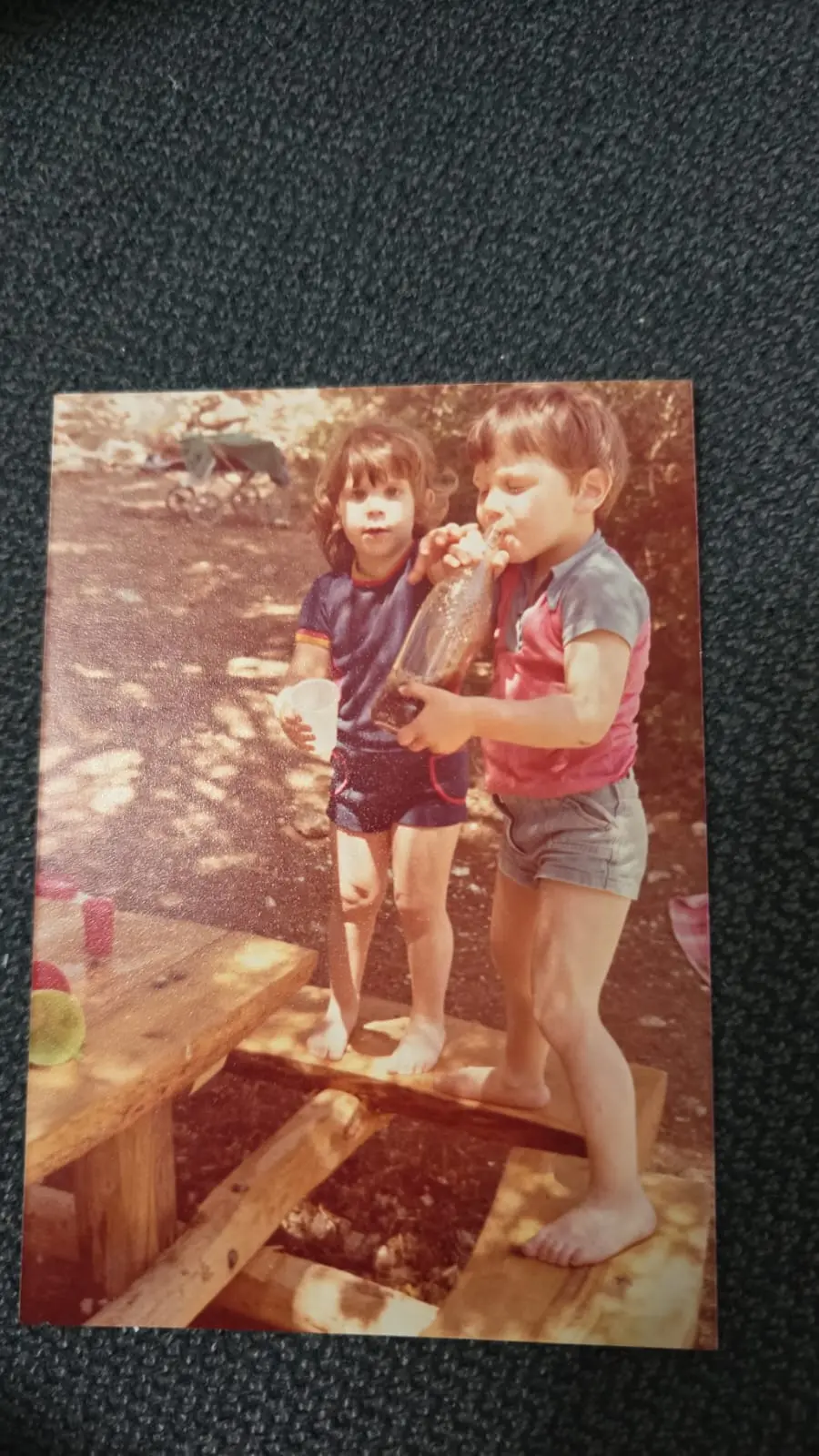
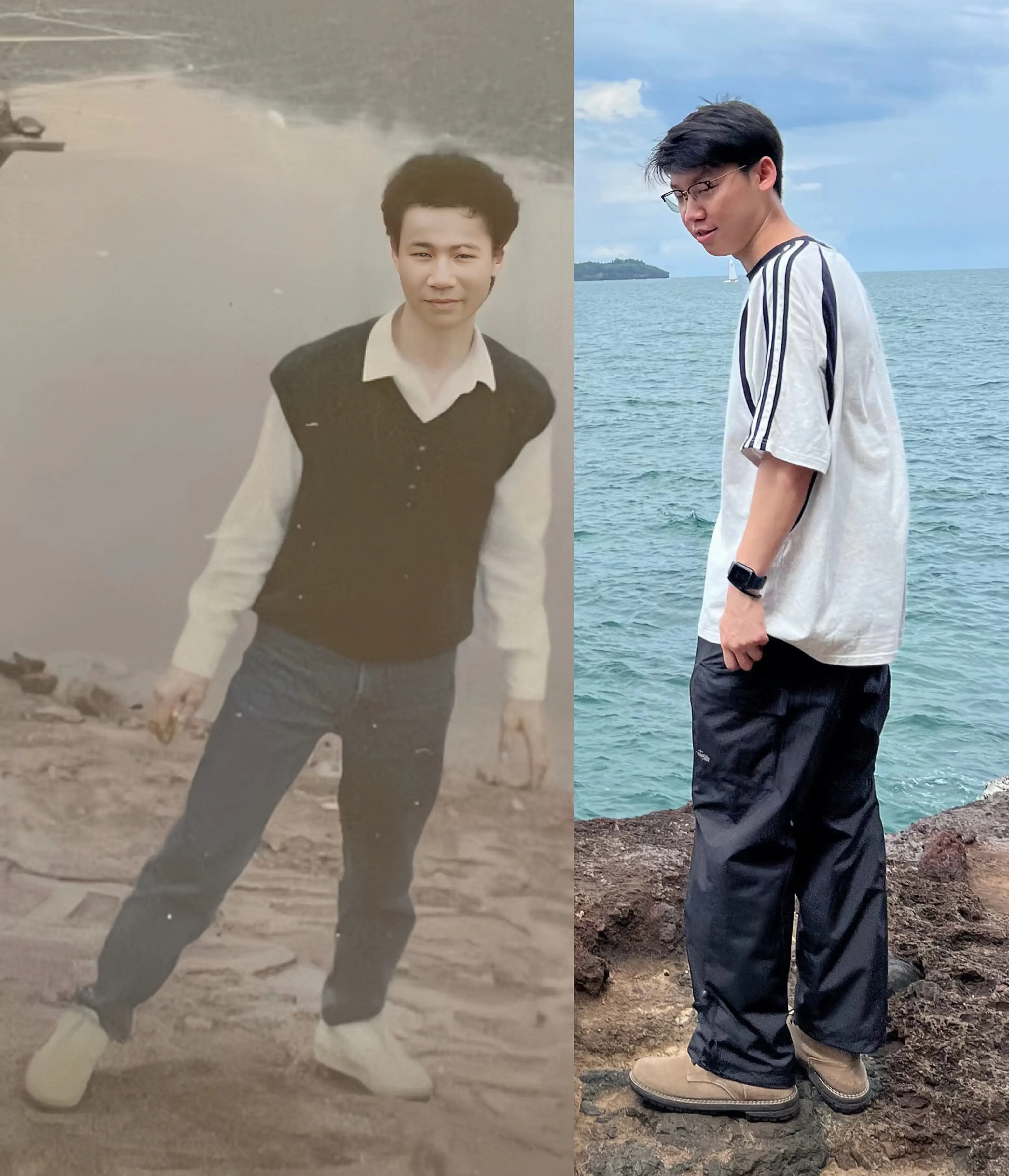
High-Quality Photos | | | |
|---|---|---|---|
Low-Quality Photos | | | |
Important Notes:
- We do not support animating photos of historically sensitive individuals or people in military uniforms. Please do not upload such photos.
- For less-clear photos, try a short, specific motion prompt or use automatic prompt generation.
3. Write a Motion Prompt (Optional)
Describe who should move and how. To make old photos move naturally, start with one subtle action, such as blinking, smiling, or a gentle head turn. For example:
- "The woman smiles gently and looks toward the camera."
- "The man turns his head slightly and blinks."
- "The two people wave slowly at the camera."
You can also leave the prompt blank and use the tool's automatic prompt generation.
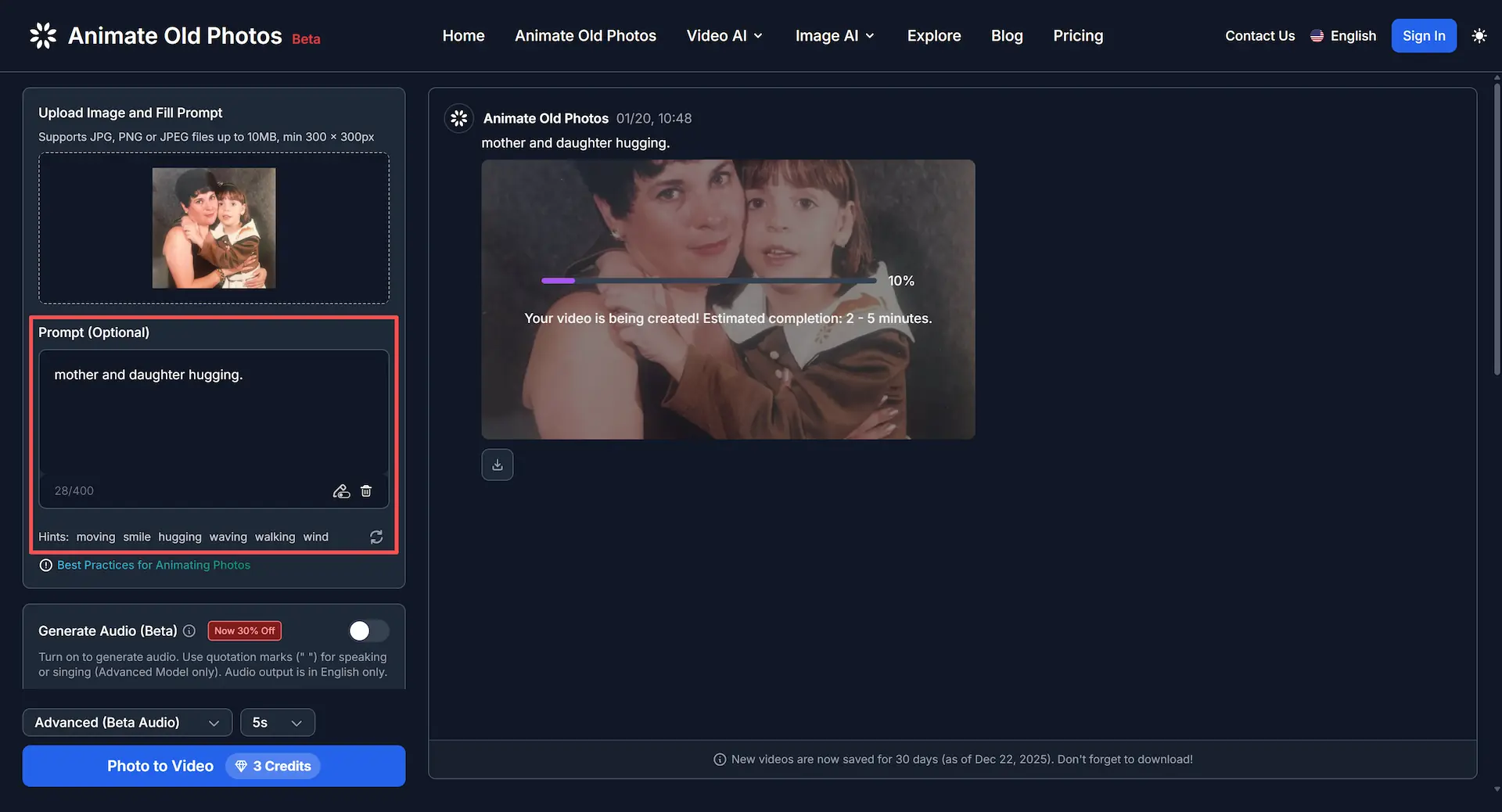
Tips for Writing Effective Prompts:
Use the formula: subject + action (optional: background motion).
- Subject: The person, animal, or object in the scene.
- Motion: The movement you want the subject to perform.
- Background: The setting of the scene.
- Keep it concise and use simple language.
- Choose movements that fit the original pose and scene.
- Avoid describing actions that contradict what is visible in the photo.
The most crucial elements of the above formula are the subject and the motion. Since the old photo-to-video generation already has the scene, you only need to describe the subject in the image and the desired motion you want the subject to perform. If multiple subjects with multiple motions are involved, list them sequentially. Animate Old Photos will then expand the prompts based on your description and its understanding of the image to generate a video that meets your expectations.
The three examples below show why the subject + action formula matters. A vague prompt such as “wear sunglasses” leaves the subject and movement unclear. “Mona Lisa puts on sunglasses with her hand” tells the model which subject moves and what action to show. You can add a separate background action, but use only as much detail as the video needs.
Prompt:
wear sunglasses
Explanation:
This prompt does not specify who should move or what movement to show, so the video mainly shows camera motion.
Prompt:
Mona Lisa puts on sunglasses with her hand.
Explanation:
Naming the subject and action makes the intended movement clear.
Prompt:
Mona Lisa puts on sunglasses with her hand, and a beam of light appears in the background.
Explanation:
This prompt combines a clear subject action with a separate background effect.
- Subject + action: Mona Lisa puts on sunglasses with her hand.
- Background action: A beam of light appears behind her.
This formula is designed to help you better utilize the old photo-to-video generation capabilities and increase the likelihood of creating videos that meet your expectations. There's still plenty of room for creativity, so explore and discover new possibilities! Here are some excellent examples to inspire you.
A few high-quality examples
4. Choose a Video Model
Select a model according to the motion, quality, and audio you need:
- Standard: A simpler option for basic photo animation without generated audio.
- Advanced: Supports higher-quality output and optional audio generation.
- Pro: Offers the most advanced motion and native-audio capabilities, including speech and singing.
Video durations and available settings vary by model. Choose the option that fits the movement and audio you want.
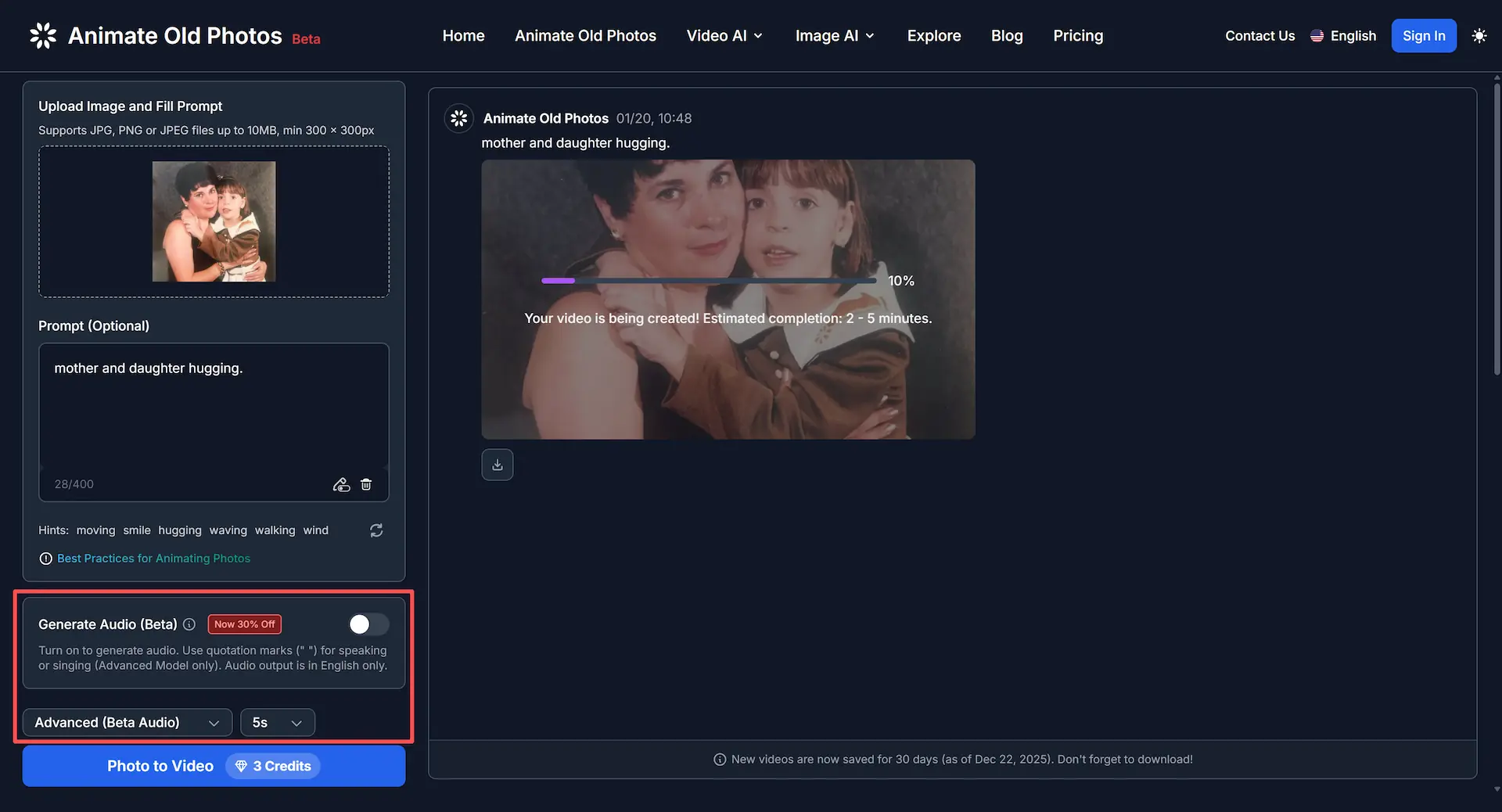
5. Enable Audio (Optional)
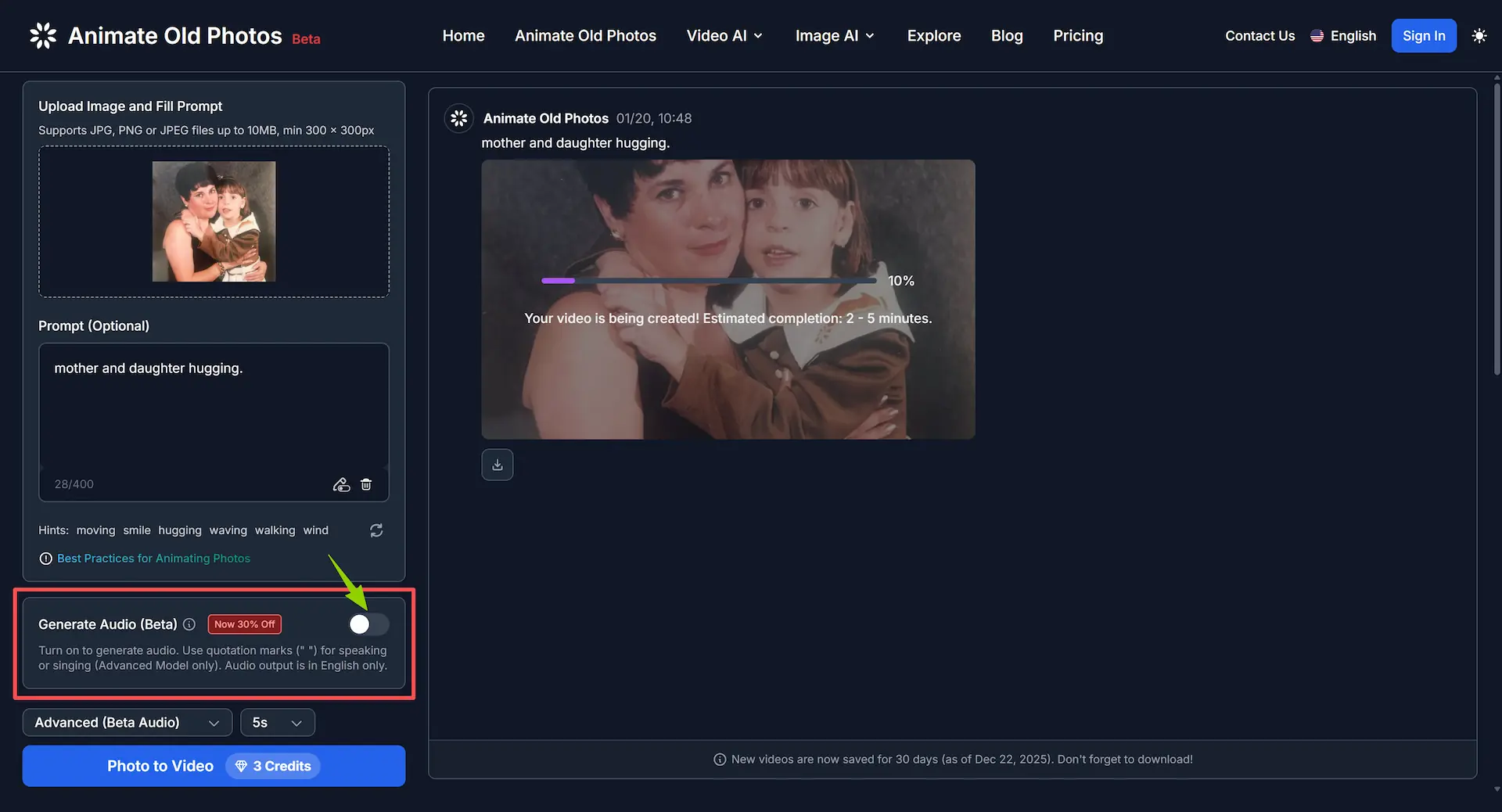
To make your animated photo speak, sing, or play background sounds, select Advanced or Pro and enable Generate Audio. Supported languages depend on the selected model:
- Pro Model: Supports native audio generation in English, Japanese, and Spanish.
- Advanced Model: Supports native audio generation in English only.
- Pro Model also provides robust support for English accents (American, British, Indian, etc.). Simply tag the desired accent for the speech content.
- If dialogue is written in a language not listed above, the model will automatically translate it into English for audio generation.
Important Notes:
- Speech, singing, and background music prompts can be written in your native language. The Pro model generates audio natively in English, Japanese, and Spanish; the Advanced model generates audio in English only. Prompts in other languages will be automatically translated into English.
- Use quotation marks (" ") for any spoken or sung lines.
- Audio can include background ambience/music, dialogue or speech (with tone), and singing.
- For dialogue and singing scenes, we recommend using the 10-second duration for more complete and stable results.
Add Background Sounds or Music
Ambient sound (nature / street / room tone):
An elderly couple sits on a porch swing, smiling gently at the camera. Background: crickets chirping, a distant train horn.
Background music:
A young couple dances close at a 1950s school gym prom, laughing softly, with warm swing band music.
If you’re not sure what music to add (universal prompt):
A family waves from the front porch on a sunny afternoon. Add fitting background music.
Add Dialogue or Speech
Tip: For multi-line dialogue, use 10s.
[Grandfather, calm and amused] says: "Look at us back then—so young." Then [Granddaughter, laughing softly] replies: "And still the best smile in the room, Grandpa."
Add Singing
Tip: For singing, use 10s.
On the front steps, [Young woman, gentle mezzo-soprano] sings: "Hold my hand and don't let go tonight." Then [Man in suspenders, warm baritone] sings: "We'll dance through the dark until the morning light." Background: 1940s jazz ballad.
6. Generate and Preview Your Video
Click Animate Old Photo to generate your video. Processing time depends on the selected model and current demand. When your video is ready, preview the movement and download the result you like.
7. Download and Save Your Animated Photo
Download the finished video and save a copy on your device so you can keep it, share it, or revisit it later.
Ready to animate your own photo?
Upload an old photo and create a video using the steps above. Start with a clear portrait and a gentle motion prompt.
Working with a damaged photo?
If scratches, fading, or blur make faces difficult to see, try Old Photo Restoration before animating. It can repair damage and optionally colorize black-and-white photos. Download the restored image and upload it here to create a video.
Tip: Keep the original photo, your prompt, and the downloaded video together so you can try a different movement later without losing the source image.
Common Questions About Animating Old Photos
Can I animate an old photo online for free?
Yes. You can animate old photos online for free with Animate Old Photos.
Do I need to write a prompt to make an old photo move?
No. A prompt is optional, and the tool can generate one automatically. If you want a particular movement, describe the person and action clearly, such as “The grandfather smiles and waves slowly.”
Can an old photo speak, sing, or have background music?
Yes. Advanced and Pro modes support optional audio. Turn on Generate Audio and specify dialogue, singing, or ambient sound in the prompt. Audio support and languages depend on the chosen model.
How can I make my old photo animation look more natural?
Use a clear photo with visible faces, a simple background, and a motion prompt that fits the original pose. Start with subtle actions such as smiling, blinking, or a gentle head turn. If your photo is faded or scratched, you can restore the old photo before animating it.
Create Heartwarming AI Hug Videos
The homepage tool can create hug videos too. Upload a photo of two people together and describe the hug in your prompt. If they are in separate photos, combine them with Merge Images, download the result, and upload it here. See our hug video guide for photo and prompt tips.
For a workflow with photo merging built into the upload area, try AI Hug. Its tutorial explains how to combine photos and generate your video without leaving the page.
Last Modified: October 11th, 2026